Related content
Add paragraph text. Click “Edit Text” to update the font, size and more. To change and reuse text themes, go to Site Styles.
Heading 4

Add paragraph text. Click “Edit Text” to update the font, size and more. To change and reuse text themes, go to Site Styles.
Heading 4
Add paragraph text. Click “Edit Text” to update the font, size and more. To change and reuse text themes, go to Site Styles.
Heading 4


H2PRO and SUN SYSTEMS GROUP Partner to Build Tarragona's First Off-Grid Solar-to-Hydrogen Plant, Scaling to 150 MW by 2032
The project will combine H2PRO’s electrolyzer technology with dedicated solar photovoltaic generation, scaling from an initial 25 MW facility toward a 150 MW RFNBO project by 2032
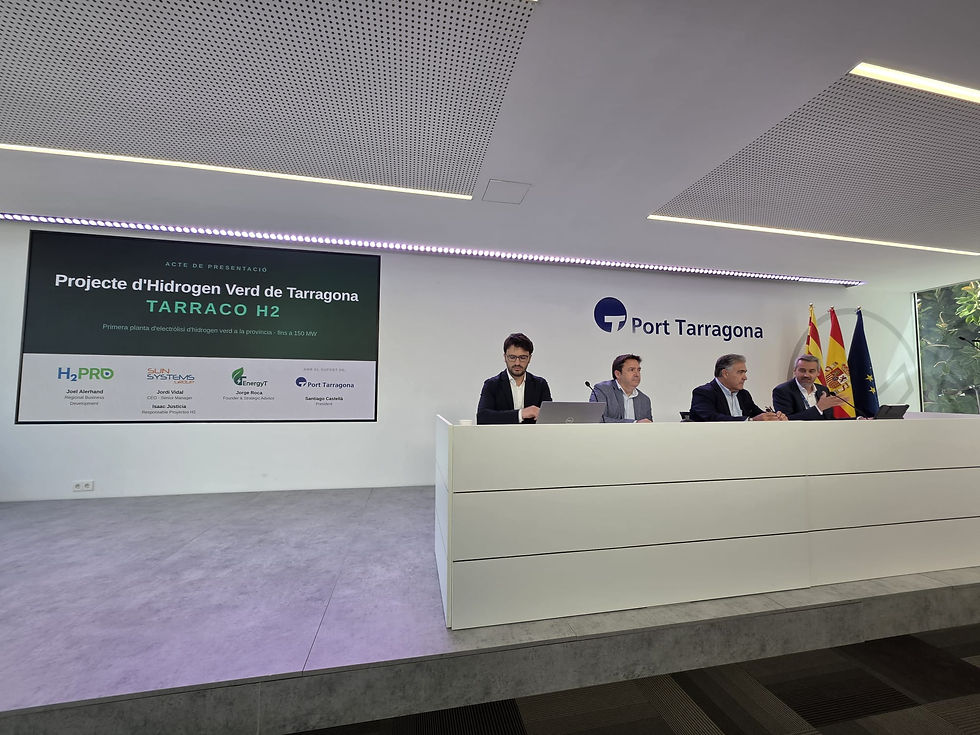
H2PRO and SUN SYSTEMS GROUP are developing a fully off-grid solar-to-hydrogen project in Tarragona, Spain, combining H2PRO’s renewable-integrated electrolyzer technology with dedicated photovoltaic generation developed by SUN SYSTEMS GROUP. The project will begin with a 25 MW electrolyzer facility, expected to produce approximately 1,250 tonnes of renewable hydrogen per year, and is designed to scale to 150 MW by 2032. The hydrogen will serve industrial users in Tarragona’s chemical and petrochemical cluster and may be injected into Enagás’ gas transportation network through blending, with future alignment to Spain’s hydrogen backbone and the H2Med corridor.
Tarragona, Spain
|
June 12, 2026
H2PRO and SUN SYSTEMS GROUP announced today the signing of a Memorandum of Understanding (MoU) to develop a fully off-grid green hydrogen production project in Tarragona, Spain.
The project is designed to produce renewable hydrogen directly from dedicated solar photovoltaic generation, without relying on electricity from the grid. It is expected to become the first fully off-grid solar-to-hydrogen project in the province of Tarragona and a strategic platform for supplying renewable hydrogen to the region’s industrial cluster.
The collaboration was initiated with the support of NORGESTION, which facilitated the initial discussions between the companies and contributed to the development of the relationship.
The project will be developed in phases, beginning with a 25 MW electrolyzer facility and expanding toward a total capacity of 150 MW by 2032. Hydrogen production will initially be supplied to industrial users and injected into Enagás’ natural gas transportation network through blending. The project has also been designed to align with the future deployment of Spain’s dedicated hydrogen backbone and the H2Med corridor.
Designed for Direct Integration with Renewable Energy
The cost of renewable electricity has declined substantially in recent years, but the same reduction has not yet been reflected in the cost of green hydrogen.
A central challenge is that conventional electrolyzers were designed to operate under stable power conditions rather than directly following the variability of renewable generation. Solar production changes throughout the day, requiring hydrogen systems to respond efficiently to intermittent operating profiles without relying extensively on grid electricity or costly backup solutions.
H2PRO develops electrolyzers specifically designed to integrate with variable renewable energy sources. The company’s technology enables hydrogen production to follow the availability of renewable electricity, supporting an operating model based on dedicated off-grid photovoltaic generation.
The Tarragona project will apply this approach at industrial scale, creating a pathway to capture low-cost solar energy when it is available and convert it directly into green hydrogen.

Development Roadmap
The project will be developed progressively, starting with a 25 MW fully off-grid hydrogen production facility powered exclusively by dedicated solar photovoltaic generation. This first phase is expected to produce approximately 1,250 tonnes of renewable hydrogen per year.
The project is designed to scale in line with market demand, reaching 50 MW of electrolyzer capacity as an intermediate milestone, with expected production of approximately 2,500 tonnes per year, and ultimately expanding to 150 MW by 2032.
The required electricity will be supplied by nearby photovoltaic plants developed by SUN SYSTEMS GROUP under a dedicated self-consumption model, with up to 220 MWp of installed solar capacity.
Phase | Electrolyzer Capacity | Expected Annual H₂ Production | Timeline |
Phase 1 (initial) | 25 MW | ~1,250 tonnes | First phase |
Intermediate milestone | 50 MW | ~2,500 tonnes | Mid-term |
Full scale | 150 MW | — | By 2032 |
Industrial Integration and Hydrogen Commercialization
The initial commercialization strategy is based on two complementary routes:
Network injection: Injection of green hydrogen into Enagás' natural gas transportation network through blending or future dedicated hydrogen infrastructure.
Direct industrial supply: Direct supply to industrial off-takers, particularly within the chemical and petrochemical sectors.
This structure provides an initial route to market while dedicated hydrogen transportation infrastructure continues to develop. Over the longer term, the project is expected to align with the future Spanish hydrogen backbone and the H2Med corridor, positioning Tarragona as a relevant node within the emerging European renewable hydrogen market.
H2PRO
H2PRO will contribute its electrolyzer technology and technical expertise for the integration of renewable generation with hydrogen production. The company develops flexible electrolysis systems designed to operate efficiently with intermittent renewable energy, enabling hydrogen production to follow the availability of low-cost solar power.
Founded based on research conducted at the Technion – Israel Institute of Technology, H2PRO holds more than ten patents and has raised approximately €100 million from leading global investors and strategic partners, including Breakthrough Energy, Temasek Holdings, ArcelorMittal and Yara International. The company has received international recognition including the Shell New Energy Challenge, BloombergNEF Pioneer recognition and the ADIPEC Award.
SUN SYSTEMS GROUP
SUN SYSTEMS GROUP will lead the development of the photovoltaic infrastructure required to supply the hydrogen production facility. The company specializes in large-scale solar projects and renewable energy solutions for industrial applications, with an established presence in Tarragona.
Its work in the region was recognized at the XXI APPORTT Awards, where it received the Quality and Sustainability Award for the development of a photovoltaic installation designed to supply a 14 MW electrolyzer project.
FAQs
Where is the H2PRO and SUN SYSTEMS GROUP hydrogen project located?
The project is located in Tarragona, Spain. It is designed to be the first fully off-grid solar-to-hydrogen project in the province of Tarragona and a strategic platform for supplying renewable hydrogen to the region's industrial cluster.
Is the Tarragona green hydrogen project connected to the electricity grid?
No. The Tarragona project is a fully off-grid green hydrogen project. It produces renewable hydrogen directly from dedicated solar photovoltaic generation developed by SUN SYSTEMS GROUP, without relying on electricity from the grid.
How much hydrogen will the Tarragona project produce?
The initial 25 MW phase is expected to produce approximately 1,250 tonnes of renewable hydrogen per year. At the 50 MW intermediate milestone, expected production is approximately 2,500 tonnes per year. The project is designed to expand to 150 MW of electrolyzer capacity by 2032.
How will the Tarragona project scale over time?
The project will be developed in phases: an initial 25 MW fully off-grid electrolyzer facility, an intermediate milestone of 50 MW, and a total capacity of 150 MW by 2032. The required electricity will be supplied by nearby photovoltaic plants with up to 220 MWp of installed solar capacity under a dedicated self-consumption model.
How will the green hydrogen be sold and distributed?
The initial commercialization strategy is based on two complementary routes: injection of green hydrogen into Enagás' natural gas transportation network through blending, and direct supply to industrial off-takers, particularly in the chemical and petrochemical sectors. Over the longer term, the project is expected to align with the future Spanish hydrogen backbone and the H2Med corridor.
Who are the partners behind the Tarragona solar-to-hydrogen project?
H2PRO contributes its electrolyzer technology and expertise in integrating renewable generation with hydrogen production. SUN SYSTEMS GROUP leads the development of the photovoltaic infrastructure. The collaboration was initiated with the support of NORGESTION.
Glossary
Off-grid green hydrogen: Green hydrogen produced exclusively from dedicated renewable energy generation, with no reliance on electricity from the public grid — ensuring full traceability of the renewable source.
Electrolyzer: A device that uses electricity to split water into hydrogen and oxygen through electrolysis. When powered by renewable electricity, the hydrogen produced is classified as green hydrogen.
RFNBO (Renewable Fuels of Non-Biological Origin): The EU regulatory classification for renewable hydrogen and derived fuels produced from non-biological renewable electricity. RFNBO status is required for hydrogen to qualify under EU renewable energy targets and the RED III directive.
Blending: The injection of a percentage of hydrogen into existing natural gas pipelines as a transitional commercialization route, allowing renewable hydrogen to reach industrial users before dedicated hydrogen infrastructure is operational.
Enagás: Spain's national gas transmission system operator, responsible for the high-pressure natural gas transportation network. Enagás is also leading the development of Spain's future dedicated hydrogen backbone infrastructure.
H2Med corridor: A planned submarine hydrogen pipeline connecting the Iberian Peninsula to France and the wider European market, designed to transport renewable hydrogen from southern Europe's high solar-generation regions to industrial demand centers in northern Europe. Endorsed by the European Commission as a Project of Common Interest.
For press inquiries, please contact: